
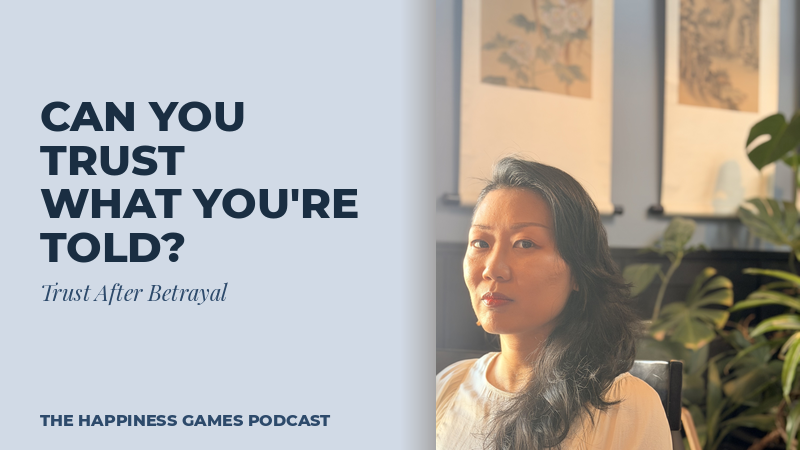
Trust After Betrayal: Why the Body Doesn't Believe What It's Told
In session after session, I hear some version of the same moment: one partner gives a full, honest explanation —
everything asked for, nothing held back — and the other partner still doesn't feel settled. Neither partner is being
stubborn or dishonest. One genuinely can't tell, in their body, whether what they're hearing is safe to lean on.
This is one of the most common — and most misunderstood — moments in couples work after a betrayal, a lie, or
any transgression that broke trust. One partner offers a full, honest explanation. The other partner hears it, and still
doesn't feel settled. Both people can walk away confused, even hurt, by that gap.
As a somatic couples therapist, I don't see that gap as a failure of honesty. I see it as a nervous system doing exactly
what it was built to do.
Trust Is Not a Belief. It's a Prediction Your Body Makes.
Neuroscientist Lisa Feldman Barrett's predictive brain framework offers a helpful way to understand this. Your brain
is constantly predicting what's about to happen, based on everything it's learned before — then checking that
prediction against what your body reports back. Part of what it's managing, moment to moment, is something like a
body budget: energy spent or saved based on what it expects is coming.
"Trustworthy" is one of these predicted categories — right alongside "safe" or "exciting." It's learned early, through
repeated experience, and it's not fixed. It can update. That update is, in many ways, what healing actually is.
This means trust in a partner was never simply a belief you hold in your mind. It's a live prediction your body is
running continuously, largely below conscious awareness — which is exactly why an explanation, even a
completely honest one, doesn't always land the way we expect it to.
When the Source Itself Becomes the Question
Here's the part that trips couples up the most. After a betrayal — an affair, a lie, any transgression — the body often
stops evaluating the specific thing being said and starts protecting against the source of the words altogether.
Once a source has been filed as "not yet safe," it can keep producing true, honest information without that filing ever
updating. This is a big part of why affair recovery so often stalls, even when the partner who broke trust is being
completely truthful in the present. More words from a source the body has already flagged as unreliable don't
automatically change the flag.
Asking for the reason again and again isn't irrational. It's a reasonable, protective response to real history — the
nervous system budgeting conservatively after a real cost. It may simply not be the mechanism that actually rebuilds
trust.
The Real (and Necessary) Risk in Rebuilding Trust
Updating a body's category from "not trustworthy" to "trustworthy" is not risk-free, and I don't think it should be
framed as though it is. At some point, it requires letting new information in through the body itself — noticing a felt
sense of ease, or the absence of it, in real time — rather than only auditing words after the fact. That is a genuine
vulnerability. It means loosening a protection that was doing exactly what it was supposed to do.
There's no shortcut that removes that risk entirely. What tends to help is pace: small, repeated, felt experiences over
time, rather than one big conversation being asked to resolve everything at once. Nervous systems tend to update
gradually, through accumulated lived experience — not through a single explanation, however complete.
Where AI Can Help — and Where It Can't
A growing number of couples are experimenting with AI tools to help process conflict or find language for a hard
conversation. There's a real, specific way this can help: Barrett's work also points to something called emotional
granularity — the range and precision of the emotion concepts a person has available. A language-based tool can
genuinely help expand that vocabulary, offering more precise words for a feeling before it's brought to a partner.
What it can't offer is the second channel trust actually depends on: the felt, physiological exchange that happens
simply because two bodies share space — breath, heart rate, the pacing of a voice. There's no nervous system on the
other side of an AI conversation to regulate alongside. It's a useful training ground for language. It is not a substitute
for two people finding each other in a room.
This distinction — between language and embodiment, between explanation and felt experience — is something I
explored somatically in my theater piece, Finding Truths, which looks at trust and mistrust through the body rather
than only through argument or explanation.
What This Means for Your Relationship
If you're in the middle of rebuilding trust with a partner — after an affair, a lie, or any transgression — a few things
may be worth holding onto:
● A full explanation is not a failure if it doesn't immediately restore trust. That's not a sign something is
wrong with either of you.
● Asking for the same reassurance repeatedly is a protective response to real history, not a character flaw.
● Trust tends to rebuild through small, repeated, felt experiences over time — not through one conversation
that's expected to settle everything.
● Tools like AI can help you find language for what you're feeling. They can't do the relational, embodied
work of rebuilding trust with your actual partner.
Working Through This Together
As a somatic couples therapist, this is the kind of work I do with couples navigating betrayal, affair recovery, and
the slower process of learning to trust again — combining nervous system awareness with the relational and
developmental frameworks that help couples understand not just what happened, but why healing takes the time it
takes.
If this resonates with where you and your partner are right now, you can read more about my approach and
background on my founder story page, or listen to the full episode on The Happiness Games Podcast, where this
topic is explored in more depth.
<iframe width="560" height="315" src="https://www.youtube.com/embed/a6gWeK8jp3Y?si=FBakowRjDRSDagyv" title="YouTube video player" frameborder="0" allow="accelerometer; autoplay; clipboard-write; encrypted-media; gyroscope; picture-in-picture; web-share" referrerpolicy="strict-origin-when-cross-origin" allowfullscreen></iframe>