
Before the Cry: What AI Is Quietly Costing Our Attachment
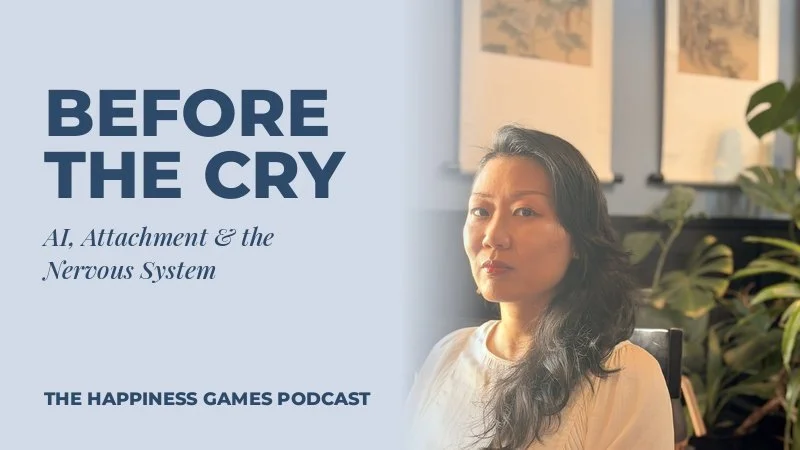
The Nervous System in the Digital Age — Episode 4
There's a commercial making its way around right now for a smart bassinet. It has a camera. It has sensors. And it can detect an infant's earliest pre-cry movement — the small shift of a limb, a change in breath — and begin rocking, gently, before a single sound is made.
For an exhausted new parent, this looks like mercy.
I want to sit with that, gently, because I think it's worth more than a passing reaction. What does it cost — the infant, the parent, and the bond forming between them — when discomfort never gets the chance to complete its purpose?
The Bassinet That Answers Before the Cry
An infant's cry isn't only a request. It's information — the earliest language a nervous system has. Hunger sounds different than boredom. Discomfort sounds different than a need for touch. Parents learn this not by being told, but by living it — by collecting thousands of small, imperfect data points until they can tell, almost before they know how they know, what their particular baby needs.
When a device answers that signal before it fully forms, three things quietly lose their chance to happen.
The infant doesn't get to build the earliest architecture of self-soothing — the capacity to sit inside a gap between need and relief, however briefly.
The parent doesn't get to build attunement — that slow, imperfect, deeply human skill of learning one specific baby's particular language of distress.
And the bond itself doesn't get its chance to strengthen. Attachment forms in the meeting of a need, not in its absence. If the need resolves before the parent ever notices and responds, the interaction that would have built the bond simply doesn't happen.
I want to be clear: none of this makes a tired parent wrong for wanting relief. Sleep deprivation is real, and reaching for something that helps is not a failure. I only want to ask, with as much compassion as I can hold, what that convenience might be quietly trading away.
The Muscle That Needs the Tear
Here's an image that might feel familiar. In strength training, lifting something heavy enough to matter actually creates small tears in the muscle tissue. It's the rest afterward — sleep, nourishment, time — that lets the tissue repair, and it's that repair which makes the muscle stronger than it was before. No tear, no rebuild, no strength gained.
The nervous system's capacity to self-regulate seems to work in much the same way. A little discomfort. A little not-knowing. A little frustration the body has to sit with and find its own way through — that is the tear. Given the room to repair on its own, the nervous system tends to come back a little more capable than it was.
The Body Already Knows How to Heal
A second image, closer to something most of us have already lived: the immune system. A common cold. A mild fever. A slightly elevated heart rate. Most of the time, the body already carries what it needs to recognize the disturbance and resolve it — without anyone stepping in. That isn't neglect. That's resilience, doing precisely what it was shaped to do.
There are times intervention is genuinely needed. But not every small sign of distress calls for outside rescue. The same capacity for self-resolution seems to live in the nervous system as it does in the immune system — and, like any capacity, it seems to stay sharp mostly through use.
The Same Architecture, Grown Up
This same pattern is showing up in how some adults are beginning to relate to AI — not only for information, but for real-time emotional validation, in the moments something hurts or feels uncertain.
I understand the pull. A well-trained therapist may spend a decade building the clinical intuition it takes to sit well with another person's pain — and even then, remains a human being with limits: unavailable at three in the morning, unavailable on vacation, unavailable while tending to their own life. An AI companion carries none of those limits. It is endlessly patient, endlessly available, never distracted by needs of its own.
But if every hint of discomfort is met instantly, before a person has the chance to sit with it and find their own way through, the tear never happens. And so neither does the rebuild. The muscle doesn't strengthen, because it is never asked to contract.
And when that same person returns to relationship with an actual human being — who cannot be endlessly patient, endlessly available — the contrast can feel enormous. I don't ask this with judgment, only with real curiosity: has the capacity to tolerate that gap, and still choose to stay in connection, had the room it needs to develop?
Where This Leaves Us
I don't think this is a question with one right answer, and I don't think it needs to be. It's simply worth noticing, with as much gentleness as we can offer ourselves — where in our own lives a gap is being closed before it's had the chance to teach us anything. Where something is meeting us so instantly, so perfectly, that we never quite get to find out what we might have figured out on our own.
Some gaps aren't emergencies. Some are where strength is still quietly being built.
Yi Zhao Martins is a somatic couples therapist working at the intersection of attachment, nervous system regulation, and Internal Family Systems. This is Episode 4 of The Nervous System in the Digital Age series on The Happiness Games Podcast.