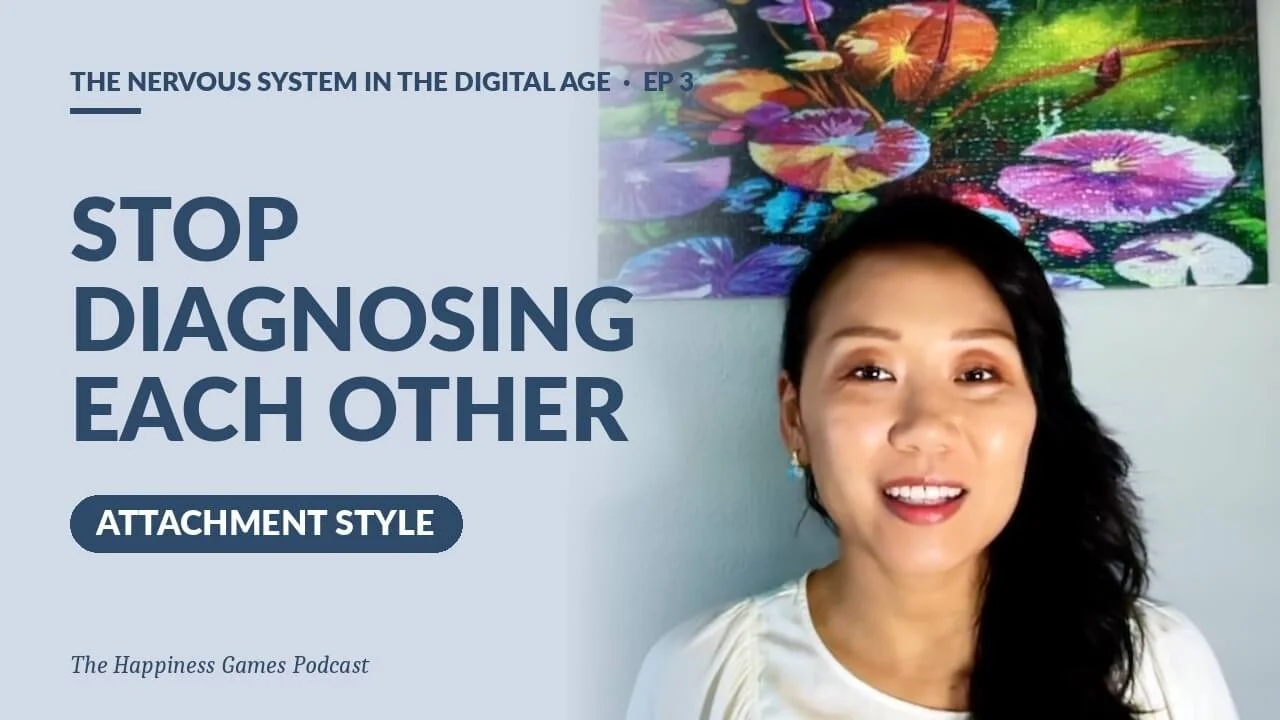
Stop Diagnosing Each Other: What's Really Underneath the "Attachment Style" Fight
"You're so avoidant." "That's your anxious attachment talking." Sound familiar? More couples are fighting with therapy language pulled from social media — turning attachment style, self-regulation, and reflective listening into weapons instead of tools. As a somatic couples therapist, I see this pattern often. Here's what's really going on underneath a pop psychology fight, and how to get out of it.
Why couples diagnose each other
Attachment theory went viral. Now partners use it to label each other mid-fight instead of understanding each other. The words get more sophisticated; the connection doesn't. This is the same digital-age dynamic we unpacked in Episode 2, "Whose Phone Is It, Really?" — technology feeding the fight instead of the relationship.
The predictive brain behind the fight
Per neuroscientist Lisa Feldman Barrett's predictive brain theory, your brain constantly categorizes people and predicts their next move — that's normal, not a red flag. It becomes a problem when the prediction gets rigid and stops updating as your partner's mood, stress, or day actually changes.
The role-lock: why the fight never ends
Blame and counter-blame ("avoidant" vs. "anxious attachment") is a stuck pattern couples therapists call a role-lock — both partners waiting for the other to change first. It can feel like danger, not intimacy, to your nervous system.
What's really underneath the label
Through an Internal Family Systems (IFIO) lens, the diagnosis is a costume. Underneath it is a part in pain, usually wanting connection, attention, respect, or to simply be seen.
Three tools to break the cycle
Know your gas and brake — notice your own pursue-or-retreat pattern before reacting.
Step out of the role — you are not the label.
Say the need plainly — skip the diagnosis, name what you actually want.
Grounding meditation: the ground beneath the argument
A short somatic practice to regulate your nervous system before or after conflict — feel your feet, lengthen your exhale, place a hand on your heart.
"I can stay open and curious. My heart can soothe the rest of my body."
More from this series: Episode 1, "The Read Receipt Between Us" · Episode 2, "Whose Phone Is It, Really?" · Browse all episodes