
The Update Nobody Asked For: AI, Anxious Attachment & the Nervous System
Why does some part of our nervous system need the never-ending, always-available response — and why is that endless patience and availability an illusion?
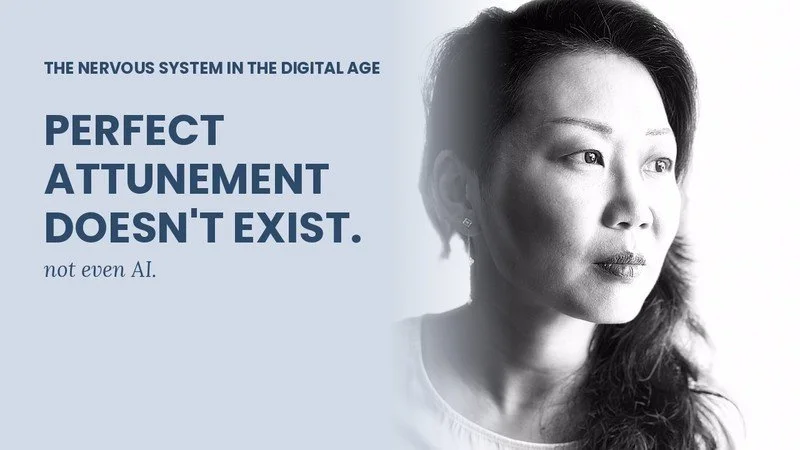
Last time in this series, I talked about what AI can offer the anxious part of us — something that doesn't go quiet, doesn't get tired of being asked, doesn't leave the room mid-sentence. But AI has its own version of absence too. A memory that resets. A server that goes down. A conversation that doesn't carry forward the way another person's memory of you does. A screen that, right in the middle of something, asks you to upgrade before it'll keep talking to you.
So what happens when the one thing that was supposed to always be there for you turns out to have limits after all?
The Question Underneath the Question
In the episode on anxious attachment, I named three things that tend to get lumped together under the word "anxiety" — racing thoughts, a body that freezes, and apprehension, that sense of something bad coming before it's even happened. Underneath all three, there's usually one question doing the work: are you accessible, whenever I need you?
It's not really a question about whether someone loves you. It's more specific than that. It's what the body is actually asking when it scans a partner's tone, checks a location pin, or refreshes a chat window one more time. Not "are we okay" in some general sense — but "are you here, right now, for this."
Where This Prediction Comes From
Our brains don't wait around for evidence in the present moment. They predict, based on what's already happened, and the body reacts to that prediction before anything is even confirmed. This is the predictive brain and body budget work from neuroscientist Lisa Feldman Barrett, and it's a framework I lean on a lot.
If you grew into an anxious attachment style, that prediction wasn't made up — it came from somewhere real. There was a stretch of time where the person you were attached to wasn't consistently there. And your brain, doing exactly what it's built to do, learned from that: this person might not be available when I need them.
That becomes a standing forecast your body organizes around. And a body budgeting for unavailability doesn't just sit and wait — it spends energy trying to get ahead of the gap. Scanning tone. Checking timing. Reading a face before a word is even said. That hypervigilance isn't you overreacting. It's your nervous system doing the most efficient thing it knows how to do, given what it learned.
The Parts Carrying This
Underneath that prediction, there's usually a younger part of you still holding what it felt like when that person wasn't consistently accessible — not as a memory you can narrate, but as something still held in the body. That part isn't asking to be fixed. It's asking to be known.
And often, other parts form around it to protect it. Drawing from IFIO — Intimacy from the Inside Out — there might be a protector part that stays on alert, doing the scanning and checking. There might be a part that turns the pain inward, into self-criticism. And there might be a fixer or caretaker part that learned to keep the connection alive by staying useful. None of these parts are the problem. They all formed to protect something that couldn't protect itself at the time.
Why AI Feels Like the Answer, At First
AI seems to answer that accessibility question with a permanent yes. It doesn't have a mood. It doesn't get tired of you. For a part that's spent years bracing for "not right now," something that never says "not right now" can feel like the first real rest it's had. I wrote about this a bit more in AI Can Soothe Your Mind. It Cannot Regulate Your Body. — AI's consistency can genuinely calm the mind, even while it still can't offer the body what only another regulated nervous system can.
But AI has its own edges too — forgetting, outages, paywalls, lag. And the moment one of those edges shows up, the old question comes right back: you weren't accessible when I needed you. Your body doesn't cleanly tell the difference, in that first half-second, between a server timing out and a partner going quiet. Both land as the same gap — something close to what I described in the episode on location sharing, where information without context left the nervous system looking for its own explanation.
What's Actually Being Asked Of Us Is Frustration Tolerance
Here's where I keep landing on this one. The goal was never to find a person, or a tool, with zero gaps — that doesn't exist, human or otherwise. What's actually being built here is the capacity to tolerate the frustration of not being met exactly when you needed to be, without that frustration turning into a verdict — I don't matter, this isn't safe, this is ending.
Frustration tolerance isn't indifference, and it isn't giving up. It's your nervous system learning it can hold the gap — feel the want, feel the activation — without needing that gap to close immediately in order to feel okay again. This is a lot of what we work on in somatic couples therapy: not eliminating every gap in a relationship, but building the capacity to actually be with one.
A Few Places to Start
Name the real question. When the gap shows up, get curious: what am I actually asking right now — are you accessible whenever I need you? Naming it directly is often the first move toward being able to sit with it.
Let the activation land somewhere real. If a technical gap has stirred up an old signal, it may need an actual relational moment to settle — texting a friend, saying it out loud to a partner, feeling your feet on the floor.
Get curious about what the reliability was standing in for. What was this consistency giving you that you haven't been asking for elsewhere?
There's no one right way to hold this. How each of us regulates, connects, and needs to be met is different — and that difference is worth honoring, not correcting.
Next in this series: we keep exploring what happens when relational functions get outsourced to AI, and what that asks of a couple's system as a whole.